
Open your FACEIT stats since Season 8 and the rating number next to your name isn't what it used to be — there's a new FACEIT Rating, a stat called Swing you've never seen before, and RWS sitting next to it. This guide explains exactly what changed, how each of these three numbers is calculated, what counts as a good value, and how they relate to (and differ from) your ELO and the rating you might know from HLTV.
What changed in Season 8
On April 22, 2026, FACEIT shipped its biggest stats overhaul since launch alongside Season 8: a brand-new FACEIT Rating that replaces the old kill/death-based number, plus two new supporting metrics, Round Swing and RWS. This isn't a cosmetic relabel — the old rating was essentially a blend of K/D, ADR and KAST. The new one is built around win probability: every action in a round is scored by how much it actually moved your team toward winning, not by whether it produced a kill.
How FACEIT Rating is calculated
FACEIT Rating scores every kill (and assist, flash, clutch) by its situational value rather than treating all kills as equal. An entry kill that opens a site, or a clutch in the final round, counts for far more than a kill, because it had a bigger effect on whether your team won the round. A kill that lands after the round is already decided — finishing off a bomb that's already planted with no defusers left, or an exit frag after the win is locked in — counts for very little, even though it looks identical on the scoreboard to the entry kill.
| Rating | What it means |
|---|---|
| < 0.89 | Below the platform-wide average performance |
| 0.89 – 1.29 | Baseline average across all FACEIT matches |
| 1.3 – 1.79 | Advanced, consistently high-impact performance |
| 1.8+ | Elite, exceptional-impact performance |
Round Swing — what it is and how it works
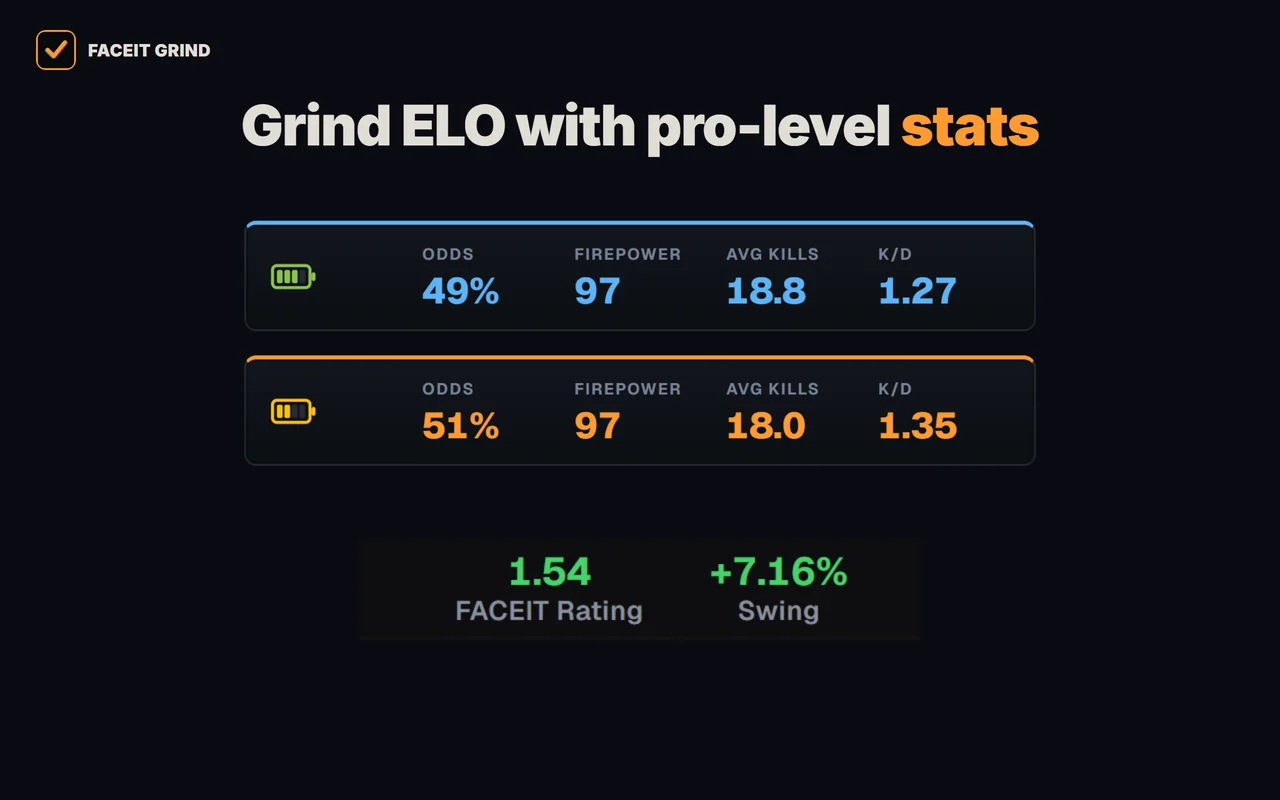
Round Swing measures how much a single action shifted your team's chance of winning the round — not whether it produced a kill. At any moment, your team has a calculated win probability based on players alive, economy, bomb state and the map. When something happens — a kill, a flash that sets one up, a bomb plant — that probability changes, and Swing is exactly how much it changed in your favor (or against you, if you die).
- A kill that turns a 2v2 into a 2v1 swings the round hard in your favor — high Swing.
- A kill in a round your team had already effectively won (last enemy, bomb defused) barely moves the needle — low Swing.
- Swing splits credit across everyone involved: damage share, flash assists, whether the kill was a trade, and the economy on both sides all factor in.
On your profile, AVG Swing is simply your average Round Swing across recent rounds — the per-action version, averaged out, the same way ADR averages your per-round damage.
RWS (Round Win Shares) — and how it differs from Swing
RWS stands for Round Win Shares: every round, the winning team is awarded 100 points total, split between its five players based on who actually contributed to that win. If a round's 100 points were divided perfectly evenly, each player on the winning side would get 20 — so an RWS consistently above 20 means you're carrying more than your share of the wins, not just padding stats in rounds your team was already losing.
The difference from Swing: Round Swing measures your probability shift on every action, win or lose; RWS only exists for rounds your team won, and tells you how much of that specific win was yours. FACEIT Rating then aggregates both, plus KAST and multi-kills, into one number across a whole match.
FACEIT Rating, ELO and Premier are three different things
| What it measures | Changes on | |
|---|---|---|
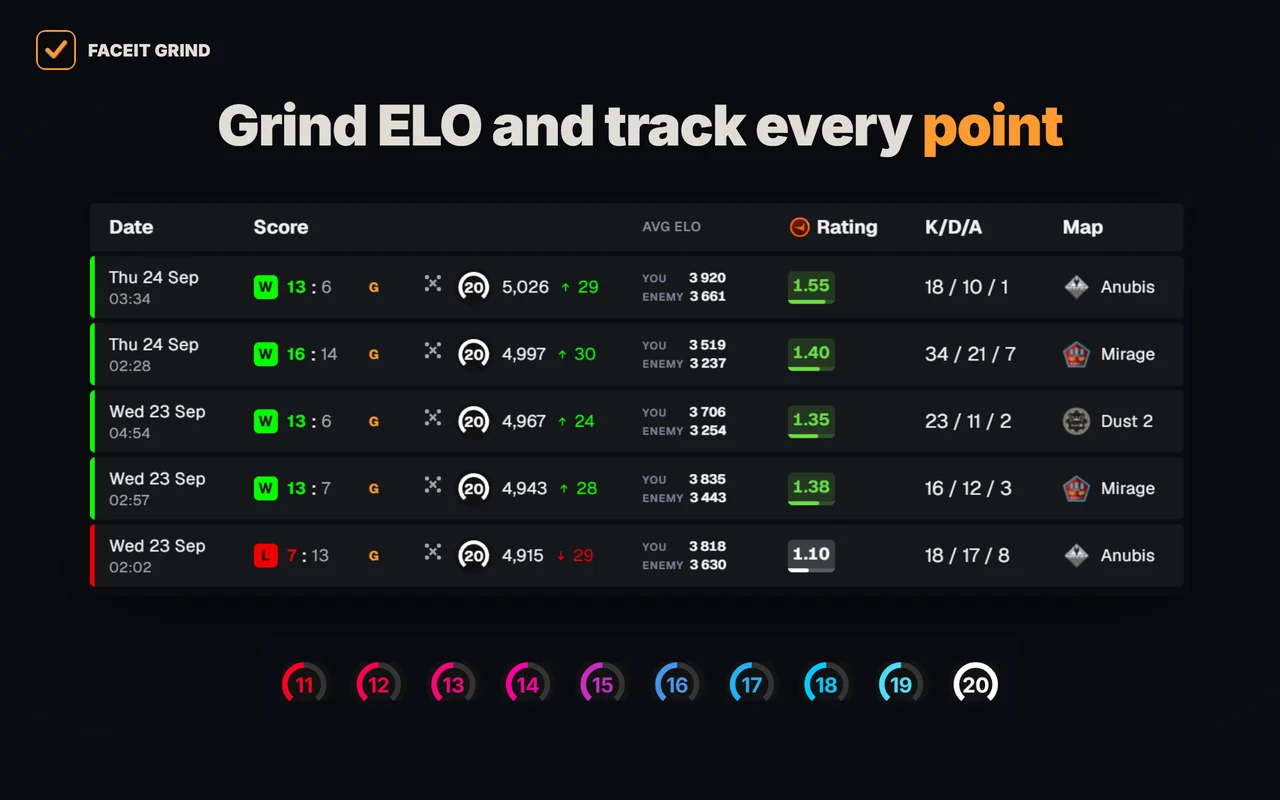
| FACEIT Rating | How well you performed (win-probability impact) | Every match, regardless of result |
| FACEIT ELO | Your matchmaking skill level (1–10) | Wins and losses only |
| Premier CS Rating | Valve's separate skill score on CS2 Premier | Wins and losses, on a different platform |
What counts as a good Rating, Swing and RWS
FACEIT publishes hard thresholds only for Rating (see the table above). For Swing and RWS, read them directionally: a higher average Swing means your actions are landing when they actually matter to the round, and an RWS consistently above the 20-point even split means you're winning more than your share of the rounds your team takes.
Bottom line
Season 8 replaced FACEIT's old kill-based rating with a win-probability model: FACEIT Rating aggregates the match, Round Swing scores each action, and RWS tells you how much of your team's wins were actually yours. None of this is ELO, and none of it is HLTV's rating — they're separate systems measuring different things. Want the full breakdown of K/D, ADR and KAST too? Read FACEIT stats explained.
FAQ
How is the new FACEIT Rating calculated?
It scores every action — kills, assists, flashes, clutches — by how much it actually shifted your team's win probability in that round, rather than treating every kill as equal. Entry kills and clutches count for much more than exit frags or kills after the round is already decided.
What is the maximum FACEIT rating?
There is no fixed maximum — FACEIT Rating is an open-ended average, not a capped score. 0.89–1.29 is the platform baseline, 1.3–1.79 is considered advanced, and 1.8+ is elite, exceptional-impact territory.
Is FACEIT Rating the same as ELO?
No. FACEIT Rating measures how well you performed in a match (win-probability impact); ELO is your matchmaking skill score that only moves on wins and losses, regardless of how you played.
What is Swing on FACEIT?
Swing (Round Swing) measures how much a single action — a kill, a flash assist, a bomb plant — shifted your team's chance of winning that specific round. AVG Swing on your profile is your average Round Swing across recent rounds.
What is a good AVG Swing on FACEIT?
FACEIT doesn't publish a fixed scale for Swing the way it does for Rating. Read it directionally: a higher average means more of your actions are landing in rounds that were genuinely close or contested, not in rounds already decided.
What is RWS in FACEIT?
RWS (Round Win Shares) is your share of the 100 points awarded to the winning team each round. An even split among five players is 20 each, so an RWS consistently above 20 means you're contributing more than your share to your team's wins.
Is FACEIT Rating the same as HLTV Rating 3.0?
No — they're separate products from separate companies. Both happen to be built around win probability and both use a "Round Swing" concept, but FACEIT Rating only exists on FACEIT and isn't calculated or published by HLTV.
When did FACEIT change its rating system?
FACEIT Rating, Round Swing and RWS launched together on April 22, 2026, with Season 8 — FACEIT's biggest stats overhaul since the platform launched.
Does FACEIT Rating affect ELO?
FACEIT has not stated that the new Rating directly changes ELO calculations. ELO still moves based on match wins and losses; Rating is a separate performance metric shown alongside it.